În așteptare…

Se temea de întuneric, dar în același timp nu putea dormi decât cu un acoperământ deasupra capului, care ascundea lumina.

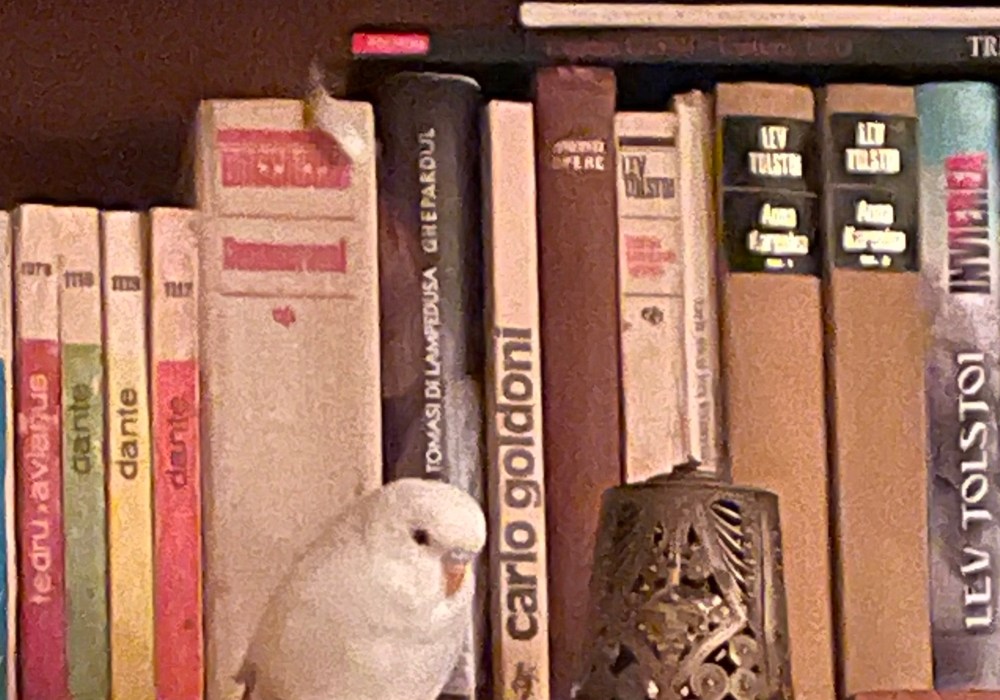
Află într-o zi că urmează a face o călătorie undeva, deși nu știa încă dacă avea să fie departe sau nu. Nu se prea pregăti, că nici nu era timp. Călătorea, de obicei, simplu, plansându-se voit – nevoit în cabine mici, întunecate, însă cu oarecare design retro, pentru a putea dormi la nevoie, dar ca să nici nu se plictisească arunci când somnul nu venea.

În sala de așteptare de la gară era frig, venise multă lume și se vorbea cam tare. Era oarecare agitație, iar el nu știa de ce. Era, oare, asta important…? “Hmm…”

I se făcu brusc foame. Erau, din fericire, câteva semințe de ronțăit și cam atât. Crezuse că avea să observe călătorii, însă decise în ultima clipă să se culce. “Când mai vine timpul plecării, odată?!”, se întreba el, în timp ce se cufunda în somn.

În lumea lui, timpul nu avea valoare, ci doar spațiile largi. Dar, în calitate de papagal peruș, el știa să aibă răbdare să înțeleagă cum merg lucrurile și în celelalte lumi și, de asemenea, să aștepte. “Va veni și timpul plecării, cât de curând”, își spunea el, ațipind ușor.

English translation

Waiting…A parrot’s short story.

He was afraid of the dark, but at the same time he could only sleep with a covering over his head that hid the light.

One day he learned that he was going to take a trip somewhere, although he didn’t know yet whether it would be far or not. He didn’t really prepare, because there wasn’t any time. He usually travelled simply, deliberately or not forced into small, dark, but somewhat retro-designed cabins so that he could sleep when needed, but also so that he wouldn’t get bored when sleep didn’t come.

It was cold in the waiting room at the train station, a lot of people had come in and it was a bit loud. There was some commotion, and he did not know why. “Was that so important…?” “Hmm…” He suddenly felt hungry. There were, thankfully, a few seeds to munch on and that was about it.

He thought he was going to observe the travelers, but decided at the last minute to go to sleep. “When will it be time to go?” he wondered as he drifted off to sleep.

In his world, time had no value, only wide open spaces. But as a Peruvian parrot, he knew how to be patient in order to understand the inner workings of the things in other worlds, and also to wait. “Soon enough it will be time to go,” he told himself, dozing lightly.

Despre slăbiciune. Margareta

“De ce”, se întreba Margareta, “de ce mi-a făcut tocmai mie așa ceva?” Nu mai avea demult bani, lucruri proprii și nici măcar casă. Vânduse tot pentru a supraviețui și locuia acum la o prietenă, undeva la marginea orașului. Dar nu de aceea era ea tristă. Suferea amar la gândul că Doctorul dispăruse fără urmă. O abandonase!

Cu cinci ani în urmă, de Sânziene, Margareta îl văzuse pentru prima dată pe Doctor – un bărbat tăcut, care ședea stingher pe o blană de lemn, privind la ea cum dansa în hora satului. O intrigase căutătura lui bizară și felul intens în care se uita la ea. Era clar străin și, pe deasupra, om de la oraș.

Nu făcuse niciun gest de a se apropia de ea. La sfârșitul horei, Margareta se așezase lângă el, cu îndrăzneala un pic grosolană a fetelor de șaisprezece ani, și-l întrebase direct de unde vine. “De pe meleaguri îndepărtate”, fusese răspunsul lui, cu oarecare apăsare în glas. Apoi, ceea ce Margaretei i se păruse de-a dreptul ciudat, omul se uită spre stânga, unde ea nu văzu pe nimeni, și făcu un semn cu ochiul în direcția aceea. Mai târziu, Margareta va afla cine stătea în stânga Doctorului.

După schimbul de cuvinte și semnul bizar cu ochiul, bărbatul se întorsese către ea, complet schimbat. Părea sigur de sine, aproape arogant, vocea îi era mai groasă și, Margareta gândea, arăta chiar mult mai tânăr. “Ce stranii sunt orășenii!”, își spusese. Cu toate că fata deja își dădea seama că nu faptul de a fi de la oraș îl separa pe acest bărbat de restul oamenilor pe care ea îi cunoștea. “Cum te numești?”, o întrebase el. “Numele meu e Margareta. Iar al dumneavoastră?” Bărbatul se uitase la ea cu o oarecare blândețe, preț de o clipă, apoi, pe un ton arogant, îi comunicase: “Eu sunt Heinrich Faust. Dar tu îmi vei spune Doctor Faust sau Faust.” Margareta nu îi respectase niciodată această regulă, numindu-l mereu, simplu, “Doctorul”.

Cu Doctorul, Margareta văzuse lumea. Călătorise, cunoscuse oameni de tot soiul, mâncase bucate și purtase haine de boieroaică și, deși nimeni nu o crede acum, când le povestește, văzuse chiar locuri din timpuri demult apuse, precum orașe din Grecia Antică. Fusese ea, oare, cu adevărat fericită? Asta nu se poate ști. Dar cu siguranță, belelele și nefericirea începuseră cu Diavolul.

Trecând odată printr-un sat, Doctorul se oprise dintr-o dată și îi spusese că trebuie să poposească acolo o scurtă perioadă. Când ea îl întrebase de ce, el îi răspunsese: “A venit timpul să îmi cunoști dușmanul și prietenul cel mai bun.” Se dădu apoi la o parte și Margareta văzu pentru prima dată un bărbat înalt, subțire, cu o gură frumoasă, dar strâmbată de un zâmbet care ei îi dădu fiori. “Acesta e Mefisto. E Diavolul în persoană.” Mefisto îi oferi mâna politicos, iar Margareta simțise impulsul de a o săruta, dar Faust o opri. “Mi-a oferit viață veșnică, faimă și putere, dar cu prețul de a-i urma dorințele bolnăvicioase oriunde mă poartă el.” Apoi continuase: “Iar acum vrea să-și bată joc de oamenii din satul ăsta, pentru că e de părere că ființa umană e slabă și capabilă de orice compromis, în schimbul plăcerilor sau al salvării propriei pieli.” Margareta era uimită și, în același timp, speriată.

Se îndreptaseră apoi către o casă pricăjită, în fața căreia ședea, pe prispă, o bătrână. “Cerem adăpost pentru două nopți”, zisese Doctorul. Bătrâna le oferise camera cea mai bună, unde se afla și o sobă, le pusese mâncare pe masă și le spusese că a doua zi, fiind Sânzienele, urma să fie sărbătoare, astfel încât ei se vor putea distra și îi vor cunoaște și pe săteni. Ce urmase apoi fu una dintre cele mai cumplite zile de care își va aminti mai târziu Margareta.

În dimineața respectivă, pe Margareta o treziseră razele soarelui și, după micul dejun, se dusese cu Doctorul la horă. Lume multă și veselie, nevoie mare! Dansase, cunoscuse mulți tineri care, la fel ca ea, odinioară, își doreau să plece din sat către o viață mai bună și mai palpitantă, și, în sfârșit, obosită, se așeză la o masă, unde îl zări pe Doctor vorbind cu niște bătrâni din sat. Uitase complet de el. Dar acum, fiind alături de Doctor, fu atentă la conversația dintre el și comeseni. Îl auzi pomeninind despre o anume sumă mare de bani și despre o propunere nemaiântâlnită – Faust le oferea sătenilor o groază de bani, în schimbul uciderii bătrânei la care ei poposiseră cu o noapte în urmă!

Margareta și acum suspină când își amintește întâmplarea. De ce, oare, nu intervenise atunci când vreo zece săteni, bărbați în toată firea, o luaseră pe sus pe bătrână, în noaptea de Zânziene, și o duseseră la marginea pădurii, dându-i apoi foc (potrivit instrucțiunilor precise ale Doctorului)? Nici ea nu știa răspunsul. Poate frică, poate o anume lehamite – Doctorul nu mai propusese moartea unui om, sub ochii ei, până atunci; în schimb, prea apucaseră să se întâmple atâtea altele, încât ea nu mai avea puterea să se lupte cu inevitabilul.

După un an, doi (nici ea nu mai știa cât trecuse de atunci), tot în ziua fatidică de Sânziene, Margareta se trezise în patul gol. Doctorul nu mai era. Pe deasupra, îi luase toate bunurile scumpe, lăsându-i numai un carnețel cu însemnări proprii, o salbă de aur, care îi aparținuse bătrânei moarte, si câteva zdrențe, pe care Margareta reușise mai târziu să le vândă la un preț mic, pentru a-și asigura de-ale gurii.

Dar Margareta nu era săracă. Trăise mai mult decât alții într-o viață întreagă, deși avea numai douăzeci și unu de ani, îl cunoscuse pe Diavol și trăise cu un doctor neumuritor.

Poveste inspirată de viață, dar și de:

1. “Faust”, Johann Wolfgang von Goethe

2. “Maestrul și Margareta”, Mihail Bulgakov

3. “Vizita”, Friedrich Dürrenmatt

4. “Diavolul și domnișoara Prym”, Paulo Coelho

5. “Ciuleandra”, Liviu Rebreanu

English translation

On weakness. Margaret

“Why,” Margaret wondered, “why did he do this to me?” She had long since lost her money, all her possessions and even her home. She had sold everything to survive, so she was now living with a friend somewhere on the outskirts of town. But that wasn’t why she was sad. She suffered bitterly at the thought that the Doctor had disappeared without a trace. He had abandoned her!

Five years ago, on Midsummer’s Day, Margaret had seen the Doctor for the first time – a silent man, sitting awkwardly on a wooden stool, watching her dance in the village hora. She was intrigued by his bizarre bearing and the intense way he looked at her. He was clearly a stranger, and a city man, too.

He had made no gesture to approach her. At the end of the evening, Margaret sat down next to him, with the slightly rude audacity of sixteen-year-old girls, and asked him directly where he was from. “From far away lands,” was his reply, with some distress in his voice. Then, which struck Margaret as downright odd, the man looked to his left, where she saw no one, and winked in that direction. Later, Margaret would find out who was standing to the Doctor’s left.

After the exchange of words and the bizarre wink, the man turned to her, completely changed. He seemed confident, almost arrogant, his voice was thicker and, Margaret thought, he even looked much younger. “How strange the city people are!” she thought to herself. Although the girl could already tell that being from the city was, in fact, not what separated this man from the rest of the people she knew. “What’s your name?” he asked her. “My name is Margaret. And yours?” The man looked at her somewhat mildly for a moment, then, in an arrogant tone, informed her, “I am Heinrich Faust. But you will call me Doctor Faust or Faust.” Margaret had never respected this rule, always calling him, simply, “The Doctor.”

With the Doctor, Margaret had seen the world. She had travelled, met people of all kinds, eaten food and worn clothes like any other aristocratic woman and, although no one believes her now when she tells the story, she had even seen places from times long gone, like cities in ancient Greece. Had she really been happy? That is not known. But surely, trouble and unhappiness began with the Devil.

Passing through a village once, the Doctor had suddenly stopped and told her that they had to remain there for a while. When she asked him why, he replied, “The time has come for you to meet my enemy and best friend.” He then stepped aside and Margaret saw for the first time a tall, thin man with a beautiful mouth, but a smile that gave her the creeps. “This is Mephisto. He is the Devil himself”. Mephisto offered her his hand politely, and Margaret felt the urge to kiss it, but Faust stopped her. “He has given me eternal life, fame and power, but at the price of following his sickly desires wherever he takes me.” Then he continued, “And now he wants to mock the people of this village, because he believes that human beings are weak and capable of any compromise, in exchange for pleasure or saving their own skins.” Margaret was amazed and, at the same time, frightened.

They then headed towards a shabby house, in front of which an old woman was sitting on the porch. “We’re asking for shelter for two nights,” said the Doctor. The old woman had offered them the best room with a stove, put food on the table and told them that the next day, being Midsummer, would be a feast, so they could have fun and meet the villagers. What followed was one of the worst days Margaret would later remember.

That morning, she had woken in the sunshine and, after breakfast, had gone with the Doctor to the feast. Lots of people and plenty of merriment! She had danced, she had met many young people who, like her once, were longing to leave the village for a better and more exciting life, and finally, tired, she sat down at a table, where she saw the Doctor talking to some of the village elders. She had completely forgotten about him. But now, being beside him, she paid attention to the conversation between the Doctor and his messmates. She heard him mention a certain large sum of money and an unheard-of proposition – Faust was offering the villagers a lot of money in exchange for killing the old woman in whose home they were staying at!

Margaret still sobs when she remembers the event. Why had she not intervened when ten or so villagers, all grown men, had picked up the old woman on Midsummer night and carried her to the edge of the forest, then set her on fire (following the Doctor’s precise instructions)? Even she didn’t know the answer. Perhaps fear, perhaps a certain weariness – the Doctor had never before proposed the death of a human before her eyes; instead, so much had already happened that she no longer had the strength to fight the inevitable.

A year or two later (she didn’t know how much time had passed since then) on that fateful Midsummer’s Day, Margaret woke up in her empty bed. The Doctor was gone. On top of that, he had taken away all her expensive possessions, leaving her only a notebook with his own notes, a gold salver, which had belonged to the dead old woman, and a few rags, which Margaret had managed to sell at a small price, to secure some food.

But Margaret was not poor. She had lived more than most people had in a lifetime, though she was only twenty-one, had met the Devil and for a while had lived with an immortal doctor.

Story inspired by life, as well as :

1. “Faust”, Johann Wolfgang von Goethe

2. “The Master and Margarita”, Mikhail Bulgakov

3. “The Visit”, Friedrich Dürrenmatt

4. “The Devil and Miss Prym”, Paulo Coelho

5. “Ciuleandra”, Liviu Rebreanu
Despre slăbiciune. Povestea lui Orion.

În apus de soare adânc, Orion se plimba pe cer, în carul furat de la Phaethon. Era fericit în bătaia vântului serii și în acel moment nu se gândea la nimic.

Fugea, în același timp, de Maestrul său, Saturn, pentru că de-acum se considera capabil să-și ia viața în propriile mâini și nu mai voia să aibă un stăpân peste deciziile sale, peste gândurile-i tumultuoase și peste haosul pe care căutase mereu să îl provoace.

Ce-i făcuse lui Phaethon era o nimica toată pe lângă ce plănuia, în isteria lui, Orion. Desigur, Phaethon avea să sufere mult când Phoebus, tatăl lui, va afla că nu mai e în posesia carului pe care, cu prea puțină tragere de inimă, i-l încredințase. Dar Phoebus era, până la urmă, ușor de păcălit și iertător. Doar îl iertase pe Hermes de năzbâtia lui și, pe deasupra, îi mai dăruise și lira sa. “Ce nătăfleț, Phoebus!”, gândea mândrul Orion.

Planul lui Orion era sa cucerească lumea pământeană și pe urmă s-o distrugă, ca să îi dea peste nas lui Saturn, să îi plătească cu vârf și îndesat pentru umilințele pe care le îndurase când Maestrul lui îi dădea plictisitoare lecții de morală sau îl împiedica să facă năsărâmbe. Acum, Orion avea controlul absolut. Avea să facă ce voia El!

Tare plictisit era Orion…Și, în adâncul sufletului, se simțea decepționat. Niciunul din zeii cerurilor nu se dovedise în stare să îl înfrunte pe El. Mai puțin Saturn, desigur, dar acesta era bătrân încă de la începutul timpului și de la facerea lumii pământene și, gândea Orion, deja cam senil. Și plictisitor de nu se poate!

Acum, însă, Orion nu se gândea la nimic. Se bucura de vântul care îi sufla în plete, de noaptea care se lăsa, pentru că, în sfârșit, Phoebus se dusese la culcare, și de certitudinea că avea să facă fapte grozave.

Vântul, în timpul acesta, îl urma pe Orion peste tot pe unde zbura cu carul furat. Orion nu vorbise niciodată cu vântul, pentru că nu îl înțelegea. Era și el un zeu, dar un zeu străin și, pe deasupra, cam ciudat. Știa numai că se numește Hanuman și că vine din Orient. Dar, cumva, acest zeu bizar reușise să ajungă în cerurile lui Saturn și ale lui Phoebus, fusese primit și lăsat în voia lui, chiar dacă, ceea ce Orion nu putea pricepe, Hanuman nu era tot timpul blând și de multe ori făcea ravagii. Mai mult, vântul era iubit de oameni, căci împrăștia norii, făcându-i loc soarelui să strălucească, dar totodată se și temeau de el. Acest lucru îl intrigase mereu pe Orion. Însă acum era prea ocupat cu planurile sale pentru a-i mai păsa de vânt.

Pe limba lui străină, vântul ba îi striga, ba îi șoptea lui Orion tot felul de povețe. Dar el nu le auzea sau nu le înțelegea.

În noaptea neagră, Saturn privea la Orion cum zboară fulgerător pe cer și se întreba cum ar putea El, Marele Maestru, să îi atingă din nou sufletul, să îl facă să înțeleagă povețele Sale și să îl ia din nou sub aripa Lui ocrotitoare. Pentru prima dată, de la Hermes încoace, Saturn se temea. Îl înfricoșa gândul că Orion este pierdut pe vecie și că va deveni, într-adevăr, o forță distrugătoare și împotriva legilor Universului. Îl trimisese pe Hermes, cu sandalele lui înaripate, să încerce să îl prindă și să vorbească cu el. Însă, spre dezamăgirea și, întrucâtva, conform așteptărilor lui Saturn, Hermes se plictisise repede și abandonase urmărirea.

Hanuman rămăsese singura speranță a lui Saturn. Era destul de puternic, inteligent și cu suficientă experiență pentru a reuși să îl convingă pe Orion să se întoarcă la Saturn și la adevăratul lui destin. Dar era, oare, Orion îndeajuns de puternic ca să îl asculte pe vânt? La acestea medita Saturn, în timp ce Orion zbura nebunește pe cer, iar Hanuman venea în urma lui.

English translation

On weakness. The story of Orion.

In the deep sunset, Orion was riding across the skies in a chariot stolen from Phaethon. He was happy in the evening breeze, and at that moment he thought of nothing.

At the same time, he was running away from his Master, Saturn, because he now considered himself capable of taking his life into his own hands and no longer wanted to have a master over his decisions, his tumultuous thoughts and the chaos he had always attempted to create.

What he had done to Phaethon was nothing compared to what Orion was planning in his hysteria. Of course, Phaethon would suffer greatly once Phoebus, his father, would find out that he was no longer in possession of the chariot Phoebus had reluctantly entrusted to him. But Phoebus was, after all, easily fooled and forgiving. He had forgiven Hermes for his mischief and, on top of that, had gifted him his lyre. “What a ninny, Phoebus!” thought the proud Orion.

Orion’s plans were to conquer the earthly world and then destroy it, and most importantly, to get in Saturn’s face, to pay him back in full for all the humiliations he had endured, such as, when Saturn gave him boring lessons or prevented him from doing something stupid. Now Orion was in absolute control. He was going to do what He wanted only.

Orion was indeed so very bored…And deep down, he was disappointed. None of the gods of the heavens had proven themselves able to face him. Except Saturn, of course, but He had been old since the beginning of time and the making of the earthly world, and, Orion thought, already a little senile, to say the least. And boring beyond belief!

Now, however, Orion thought nothing of it. He enjoyed the wind blowing in his hair, the night that was falling, because Phoebus had finally gone to bed, and the certainty that He was going to do great things.

The wind, meanwhile, followed Orion wherever he flew in his stolen chariot. Orion had never spoken to the wind because he didn’t understand him. He was a god too, but a foreign god, and a strange one at that. Orion only knew that his name was Hanuman and that he came from the Orient. But somehow this strange god had made it to the skies of Saturn and Phoebus, had been welcomed and left on his own devices, even though, what Orion could not understand, Hanuman was not always gentle; he often wreaked havoc. Moreover, the wind was also the friend of men, when it blew off the clouds from the sky to make way for the sun to shine upon the earthly world. Though he was, at the same time, feared by men for his destructive deeds. This had always intrigued Orion. But Orion was now too preoccupied with his plans to care about the wind.

In his foreign tongue, the wind was either shouting or whispering to Orion all sorts of stories, which Orion either did not hear or could not understand. In the dark night, Saturn watched Orion fly swiftly through the skies and wondered how He, the Great Master, could touch his soul again, make him understand his stories and take him under his protective wing once more. For the first time since Hermes, Saturn was afraid. He dreaded the thought that Orion was lost forever and would indeed become a destructive force and against the laws of the Universe. He had even sent Hermes, in his winged sandals, to try to catch Orion and talk to him. But, to Saturn’s dismay and, somewhat as He expected, not long after, Hermes had grown bored and abandoned the chase.

Hanuman remained Saturn’s only hope. He was strong enough, intelligent enough and experienced enough to speak up and convince Orion to return to Saturn and to his true destiny. But was Orion strong enough to listen to the wind? Saturn was meditating upon these thoughts, while Orion was flying madly through the skies, followed by Hanuman.

Despre slăbiciune. O scurtă introducere

S-a așezat lângă domnul în vârstă, de lângă singurul loc cu căldură din bar, și l-a întrebat de vorbă. Tânărul voia să știe, în realitate, ce este “slăbiciunea”.

Domnul în vârstă își începu scurta explicație. “Slăbiciunea”, zise el, “nu este, în primul rând, absența forței”. Apoi continuă: “Slăbiciunea este un principiu puternic, în sine. Ea te ajută să te înțelegi pe tine însuți și să te dezvolți spiritual. Atunci când ești slab, te vezi cu adevărat. Îți vezi forța, destinul, potențialul, atuurile, defectele; afli cine îți este alături, cine te disprețuiește, cine te iubește, cine îți este dușman și cine te urăște. Am multe povești despre slăbiciune, pentru că este, într-adevăr, fascinantă. Dar ție îți voi spune numai una.”

“Cândva trăia o femeie cu doi câini. Iubea mult animalele, în special câinii, și vrusese să îi salveze de la moarte. Așa că îi adoptase. Într-o zi veni la ea un polițist, care îi spuse că, din cauza larmei, deranjante pentru vecini, e nevoie să îi ia câinii și să îi ducă la un adăpost. <<Din păcate, nu îmi este permis să divulg adresa sau numele adăpostului. Dar dumneavoastră vă este permis să îi readoptați după două săptămâni, la finalul reeducării lor, dar nu mai târziu de patru săptamâni, pentru că atunci vor fi considerați câini ai străzii și vor trebui uciși. Așa e legea.>> Acestea fiind spuse, polițistul ia câinii, în timp ce femeia, îngrijorată, îi înmâna lesele, botnițete și documentele legale ale câinilor.”

Trecu o săptămână, timp în care femeia a încercat să afle unde era adăpostul respectiv, însă fără succes. La finalul celei de-a doua săptămână era deja disperată. Mai încercă, totuși, să caute în toate părțile, poate, poate va reuși să își recupereze câinii adorați. În ciuda tuturor eforturilor, nu fu posibil să afle nimic. Se puse pe plăns, își smulse părul din cap, se lovi de cei patru pereți ai holulețului unde mai demult dormeau cățeii și apoi decise că sunt deja morți, iar ea trebuie să meargă mai departe. Poate va adopta alți câini sau pisici, care au nevoie de ajutor și așa se va simți mai bine.”

“Trecu o vreme, iar la un moment dat, în timp ce își plimba noul cățel, femeia văzu la o oarecare depărtare pe unul dintre câinii <<morți>>. Fu în același timp bulversată și fericită. Câinele avea acum alt stăpân, nu mai era al ei, dar era în viață. Celălalt poate fusese și el adoptat sau era într-adevăr, mort. Suferi un pic la gândul că, probabil, cel de-al doilea nu supraviețuise, însă se consolă cu gândul că ea facuse tot ce îi stătea în putință să îi salveze pe amândoi și că macar unul trăia.”

Domnul în vârstă își încheiase povestirea. “Ce părere ți-a făcut această femeie?”, întrebă domnul în vârstă. “Era slabă sau nu?”, întrebă tânărul, știind deja răspunsul.

English translation

On weakness. A brief introduction

He sat down next to the elderly gentleman, beside the only warm place in the bar, and asked him for a chat. The young man actually wanted to know what “weakness” was.

The elderly gentleman began his brief explanation. “Weakness,” he said, “is not primarily the absence of strength.” Then he continued, “Weakness is a strong principle, in itself. It helps one understand himself, and develop spiritually. When you are weak, you really see yourself. You see your strength, your destiny, your potential, your strengths, your flaws; you find out who is with you, who despises you, who loves you, who is your enemy, and who hates you. I have many stories about weakness, because it is indeed fascinating. But for you I only have this one.”

“Once there lived a woman with two dogs. She loved animals so very much, especially dogs, and had wanted to save them from death. So, she had adopted these two. One day a policeman came to her and told her that because of the noise, which was disturbing the neighbours, he needed to take the dogs to a shelter. That being said, the policeman takes the dogs away, while the worried woman hands him the leashes, muzzles and the dogs’ legal papers.”

“A week passed, during which time the woman tried to find out where the shelter was, but with no avail. By the end of the second week she was already desperate. She kept trying, however, to search everywhere, maybe, just maybe, she would get her beloved dogs back. Despite her best efforts, she was unable to find anything. She sat down, pulled her hair off of her head, bumped against the four walls of the small corridor where the dogs had once slept, and then decided that they were already dead, and that she must move on. Maybe she’ll adopt other dogs or cats who need help and that way she will feel better.”

“Some time passed, and at one point, while walking her new dog, the woman saw one of the <<dead>> dogs some distance away. She was at the same time bewildered and happy. The dog now had a new owner, was no longer hers, but it was alive. The other had perhaps been adopted as well, or was indeed dead. She suffered a little at the thought that perhaps the second one had not survived, but consoled herself with the thought that she had done her best to save them both and that at least one was alive.”

The elderly gentleman had finished his story. “What did you think of this woman?” asked the elderly gentleman. “Was she weak, or not?” the young man asked, already knowing the answer.

Muntele Sacru / The Sacred Mountain

English translation following the Romanian text.

A sunat clopotul de patru ori. ”Ce înseamnă asta?”, se întrebară cu toții. După cum bine știa toată lumea, când suna clopotul o singură dată însemna că a răsărit Soarele. Dacă suna de două ori, Soarele se pogora pe Muntele Sacru pentru a aduce binecuvântări. Dar acest lucru se întâmpla rar, de obicei o data la două sute patruzeci si patru de zile, niciodata când mările erau agitate și întotdeauna noaptea.

Pentru că numai noaptea Soarele își înceta strălucirea și se preschimba în Călătorul Negru, singuratic și plin de Darurile Mântuirii, pe care locuitorii Muntelui Sacru le așteptau cu atâta nerăbdare. Dar, desigur, dacă mările se învolburau, Călătorul Negru era chemat în valurile lor și se îneca, iar darurile Lui se pierdeau în apele învolburate. Atunci locuitorii Muntelui Sacru intrau sub blestemul Lunii, pierzându-și sensul vieții; atunci suna clopotul de trei ori și se spunea că unii dintre locuitorii Muntelui Sacru se avântau în Codrul Vrăjit, unde se preschimbau în mituri veșnice, despre care toți își aminteau, nemaivazându-i pe aceia însă niciodată. Alți locuitori, dimpotrivă, rămâneau la casele lor, dar uitau cine sunt. Alte două sute patruzeci și patru de zile trebuiau să treacă până când Soarele ar fi încercat din nou să se pogoare printre ei, cu Darurile Sale, pentru ca locuitorii rămași în uitare să se deștepte și să se întoarcă la viețile lor.

De mulți ani, locuitorii Muntelui Sacru trăiau în uitare. Nu le mai rămăseseră decât așteptarea Călătorului Negru, amintirea miturilor din ce în ce mai numeroase și cunoașterea bătăilor clopotului, care de atâta timp suna numai o dată sau de trei ori.

Însă acum se întâmplase ceva nemaipomenit. Clopotul sunase de patru ori. Iar la scurt timp după aceea, locuitorii începură să vorbească despre un anume călător singuratic, dar care nu ar fi, totuși, Soarele și despre care ei credeau că ar fi fost, de fapt, un mit.

“Dar miturile nu pot fi văzute.”, spuneau unii. Poate că Luna, după atâta timp, le lua acum nu numai amintirile, ci și mințile…”, gândeau alții. De atâta amar de vreme, Călătorul Negru era înghițit de valurile mării, iar Darurile Mânturirii fuseseră toate, rând pe rând, mistuite.

Călătorul misterios apărea deseori acum printre locuitori, mereu tânăr și bătrân, ieșind mereu din Codrul Vrăjit și întorcându-se mereu acolo.

Nimeni nu îndrăznea să intre în vorbă cu dânsul. Prezența lui era atât de trecătoare, încât de fiecare dată când locuitorii încercau să se țină după el, dispărea ca prin vrajă. Soarele însă, din înaltul Cerurului, îl urmărea atent. Îi aștepta reîntoarcerea în codru, pentru ca, de fiecare dată când Călătorul se cufunda în visare și se ridica deasupra coroanelor copacilor, să îl atingă cu razele Sale. Când se deștepta, Călătorul uita cine fusese și încotro se îndrepta. Însă Soarele știa că odată, demult, Călătorul cel fără de țintă fusese poet. Și îl urmărea, din înălțimile Sale, cum colindă Muntele sacru, cum se preschimbă în bătrân și cum revine în Codrul Vrăjit. Iar atunci, împreună cu Vânturile Muntelui Sacru, Soarele îi redeștepta amintirile versurilor pierdute. Dar Soarele nu putea schimba Sorocul.

Soarele cunoștea Sorocul atotputernic și neprevăzut și se încredea în El. Știa că Sorocul era cel care de atâta vreme Îl îneca în mare, pentru ca Darurile Sale să se piardă, iar Luna să îi blesteme necontenit pe locuitorii Muntelui Sacru. Dar tot Sorocul făcuse ca un trist poet rătăcitor, cândva demult, să găsească unul dintre aceste Daruri neprețuite, pe care apoi îl păstrase, neștiindu-i valoarea și, în timp, uitând de el. Soarele Îl chema pe Călător mereu la El, în vis, și Îi redeștepta versurile pierdute, sperând ca, cu voia Sororcului, din aceste versuri să se releve și Darul mult sperat, unica șansă la Mântuire.

Luna privea și Ea la Călător. Ajunsese palidă, istovită de blestemele pe care era nevoită să le arunce asupra locuitorilor Muntelui Sacru, de când Sorocul Îl tot îneca pe Soare în mare. Și așa de istovită cum era, Luna alunecă odată de pe Cer și se pomeni alături de Călător, în timp ce acesta visa că plutește deasupra coroanelor copacilor. Atunci Ea Îl atinse ușor, iar acesta se deșteptă ca dintr-o lungă amorțire.

Acum Călătorul Își amintea tot. Fusese poet, fusese bătrân, colindasem mult și fără țintă, iar versurile Sale erau acum mai vii în mintea Lui decât chiar atunci când le crease.

Ghidat de Soare și de Lună, Poetul se reîntoarse în satul unde se aflau locuitorii Muntelui Sacru. Aceștia Îl înâmpinară ca pe un vechi prieten de care le fusese dor și pe care nu îl mai văzuseră de o veșnicie. Poetul le împărtăși versurile Sale, în care se vorbea despre o călătorie mitică printr-un codru vrăjit, despre Soarele care apunea în mare, despre Eroul care le aducea oamenilor Darurile vieții și despre Luna care redeștepta fantezia și creația lirică.

Pe Munte, oamenii din sat au ascultat povestea Poetului și au recitat-o apoi seri de-a rândul. Se întruneau la casa unui bătrân care suna clopotul de patru ori, pentru a vesti că e timpul să se înceapă rostirea primului Basm al Omenirii.

Acum fiecare om, bătrân sau copil, înțelegea tainele Soarelui și pe cele ale Lunii, misterul Creației Divine și puterea Sorocului, nemaitrăind niciodată în uitare. Din atâtea mituri, ei creară basmele. Iar la fiecare două sute patruzeci și patru de zile, când avea loc Marea Sărbătoare, ei se adunau pentru a recita în ordine toate basmele, de la primul până la ultimul.

Doamnei profesoare Sorina Gramaticescu, de la care am învățat engleza literară.

Poză făcută de Aravinda Ravibhanu Sumanarathna.

English translation

The bell rang four times. ”What does that mean?”, they all wondered. As everyone knew, ringing the bell once meant the sun had risen. If it rang twice, the Sun was descending on the Holy Mountain to bring blessings. But this happened rarely, usually once every two hundred and forty-four days, never when the seas were rough and always at night.

For only at night did the Sun cease Its brilliance and change into the Dark Traveller, lonely and full of the Gifts of Salvation, which the inhabitants of the Sacred Mountain so eagerly awaited. But, of course, if the seas swirled, the Dark Traveller was called into their waves and drowned, and His gifts were lost in the swirling waters. Then the inhabitants of the Sacred Mountain would come under the curse of the Moon, losing their sense of life; then the bell would ring three times, and it was said that some of the inhabitants of the Sacred Mountain would plunge into the Bewitched Grove, where they would be transformed into eternal myths, which they all remembered, but never saw. Other inhabitants, on the contrary, stayed in their homes, but forgot who they were. Another two hundred and forty-four days had to pass before the Sun would again try to descend among them with His Gifts, so that the inhabitants who remained in oblivion would awaken and return to their lives.

For many years, the inhabitants of the Sacred Mountain had lived in oblivion. All that remained for them was to wait for the Dark Traveller, to remember the ever-increasing myths, and to know the bell that for so long had rung only once or three times.

But now something extraordinary had happened. The bell had rung four times. And soon after, the inhabitants began to talk about a certain lone wanderer, who was not however the Sun, and whom they believed to be a myth.

“But myths can’t be seen,” some said. Perhaps the Moon, after all this time, was now taking away not only their memories, but their minds as well…”, thought others. For so long, the Dark Traveller had been swallowed by the waves of the sea, and the Gifts of Salvation had all been consumed, one by one.

The Mysterious Wanderer now often appeared among the inhabitants, always young and old, always coming out of the Enchanted Grove and always returning there. No one dared to speak to Him. His presence was so fleeting that, whenever the inhabitants tried to follow Him, He would disappear as if by magic. But the Sun, high above in the Skies, watched Him closely. He awaited the Wanderer’s return to the Grove, so that each time the Wanderer sank into reverie and rose above the crowns of the trees, the Sun would touch Him with His rays. When He awoke, the Wanderer forgot who He had been and where He was going. But the Sun knew that once, long ago, the aimless Wanderer had been a poet. And He watched Him, from His heights, as the Mysterious Wanderer walked the Sacred Mountain, as He changed into an old man and returned to the Enchanted Grove. And then, together with the Winds of the Sacred Mountain, the Sun reawakened His memories of lost verses. But the Sun could not change the Destiny.

The Sun knew the all-powerful and unpredictable Destiny and trusted in Her. He knew that it was Destiny who had for so long drowned Him in the sea, so that His Gifts would be lost, and the Moon would curse the inhabitants of the Sacred Mountain unceasingly. But it was the Destiny Herself who had also caused a sad wandering poet, once long ago, to find one of these priceless Gifts, which he then kept, not knowing its value and, in time, forgetting it. The Sun called the Wanderer to Himself again and again, in the Wanderer’s dreams, and reawakened His lost verses, hoping that, with the will of the Destiny, from these verses the long-hoped-for Gift, the only chance of Salvation, would be revealed.

The Moon also looked at the Wanderer. She had grown pale, exhausted by the curses She had had to cast on the inhabitants of the Sacred Mountain since the Destiny had been drowning the Sun in the sea. And weakened as She was, the Moon once slipped from the Sky and laid beside the Wanderer, as He dreamed of floating above the crowns of the trees. Then She touched Him lightly, and He awoke as if from a long numbness.

Now the Wanderer remembered everything. He had been a poet, He had been an old man, He had wandered far and wide, and His verses were now more vivid in His mind than ever, more so than when He had created them.

Guided by the Sun and the Moon, the Poet returned to the village where the inhabitants of the Sacred Mountain lived. They welcomed Him as an old friend they had missed and had not seen for ages. The Poet shared with them His verses, which told of a mythical journey through a bewitched forest, of the Sun setting in the sea, of the Hero bringing people the Gifts of Life, and of the Moon reawakening fantasy and lyrical creation.

On the Mountain, the people of the village listened to the Poet’s story and recited it for evenings. They gathered at the house of an old man who rang the bell four times to announce that it was time to begin the telling of Mankind’s first Fairy Tale. Now every man, old and young, understood the secrets of the Sun and the Moon, the mystery of Divine Creation and the power of Destiny, never to be forgotten. From so many myths, they created fairy tales. And every two hundred and forty-four days, when the Great Feast took place, they gathered to recite all the fairy tales in order, from the first to the last.

To my teacher Sorina Gramaticescu, who has taught me literary English.

Featured image by Aravinda Ravibhanu Sumanarathna.

Poveste într-un sat / Story in a village

English translation following the Romanian text.

Un poet, mergând fără țintă, se rătăci într-un codru pustiu. Era obosit și înfometat. Se așeză pe iarbă, la umbră, și privi în sus, la coroanele copacilor care lăsau lumina să pătrundă. Poetul închise ochii și se imagină deasupra coroanelor copacilor. Nu atingea nimic. Dar toate îl atingeau pe el. Lumina îl atingea, frunzele îl atingeau, aerul îl atingea. Toate convergeau către el, în timp ce el se dizolva și devenea lumină, aer, copaci, sunet, fiind tot și nimic, în același timp. Poezia dispăruse, iar el nu mai era poet. Nu mai avea gânduri, nici voință, nici sentimente. Era doar creație.

“Ce vis frumos!” Se trezi. Simțindu-se mai odihnit, porni la drum. Parcă și foamea i se dusese. Încercă să își amintească niște versuri pe care le scrisese mai demult. Dar nu putu. Cum părea că începe să își amintească, o pală de vânt îi ștergea, de fiecare dată, versurile din minte.

Încercă să își amintească de trecut, de oameni cunoscuți, întâmplări, însă mereu și mereu, razele soarelui, care pătrundeau printre crengi, îl orbeau și îi întunecau memoria. Neamintindu-și de ce plecase la drum sau încotro se îndrepta, ajunse în cele din urmă la marginea unui sat.

Pășind pe o uliță cu case și garduri de o parte și de alta, el vedea oameni, care stând pe uliță și sporovăind, care trebăluind în gospodărie. Pe măsură ce fostul poet trecea, oamenii se opreau din ce făceau și se uitau la el, curioși. “Cine este acest om ciudat?”, se întrebau unii. “Pesemne că a pătruns în codru fără să fi avut vreo țintă”, ziceau alții.

Încetul cu încetul, oamenii începură să se ia după el. Până când un bătrân îl prinse de braț și îl opri. “Încotro te îndrepți?”, îl întrebă bătrânul. “Nu știu”, răspunse fostul poet. Bătrânul îi explică atunci că oricine se avântă în codrul de langă satul lor, fără vreo țintă, se pierde pe el însuși. Dar fostul poet îi spuse că, deși nu își amintește cine este și încotro se îndreaptă, nu se simte deloc pierdut.

Bătrânul îl rugă să poposească la el în colibă, până a doua zi. Îi dădu de mâncare, iar fostul poet mâncă, cu toate că nu îi era deloc foame. Bâtrânul îi spuse că el însuși fusese odată, demult, în acel codru, fără vreo țintă, și că de atunci rămăsese în satul acela, devenind pesemne alt om, pentru că nu își amintea cine fusese înainte de peripeția prin codru.

“Sunt și alții din sat tot așa, iar ceilalți s-au născut aici și știu să nu se avânte niciodată în codru, decât numai dacă știu pentru ce.” Bătrânul îi spuse apoi că a doua zi ar trebui să se apuce să își construiască o casă în satul lor și să rămână acolo, pentru că, oriunde altundeva s-ar duce, ar fi pierdut pe vecie și neînțeles de nimeni.

Dar fostul poet își păstrase, totuși, o urmă de identitate, cu toate că era vagă. Îi răsări întrebarea dacă nu cumva bătrânul și toți acești oameni trăiau în afara timpului și al destinului lor pentru că așa aleseseră, dar că acest lucru nu îi era sortit lui. Și simpla această întrebare era dovada că, în străfunduri, conștiința lui se lupta cu codrul.

Adormi cu un singur gând – să se întoarcă în acea pădure vrăjită. Avu un somn adânc, fără vise, iar când se trezi, văzu casa pustie. Bătrânul dispăruse. Dar acum el însuși se simțea bătrân. Și își amintea că avea treburi în ogradă. Se miră de aceste schimbări ciudate, însă înțelese totul când își privi mâinile și își simți barba aspră – el era bătrânul.

Părăsi coliba și se îndreptă spre codru, unde barba îi dispăru încetu cu încetul, mâinile îi reîntineriră, amintirile bătrânului fură șterse de razele soarelui, iar vântul îi readuse poeziile și amintirile din trecutul de poet. Suspină, pentru că acum era iar poet, dar fără țintă.

Colindând prin codru, obosi și se culcă, și din nou se ridică, în vis, deasupra coroanelor copacilor. Și tot așa, uita și renăștea și îmbătrânea și se pierdea, căutându-se pe sine, nestatornic, veșnic legat de codru, devenind astfel simbolul însuși al mitului veșnic. Satul era și el plin de mituri, însă acelea, fiind legate de sat, se statorniciseră și nu se schimbau decât puțin câte puțin, până ce dispăreau.

În amintirea tatălui meu, logicianul și filosoful Călin Candiescu.

English translation

A poet, walking aimlessly, wandered into a deserted wood. He was tired and hungry. He sat down on the grass in the shade and looked up at the crowns of the trees, which gave plenty of room for the light to shine through. The poet closed his eyes and pictured himself above the treetops. He wasn’t touching anything. But everything was touching him. The light touched him, the leaves of the trees touched him, the air touched him. All converged on him, as he dissolved and became light, air, trees, sound, being everything and nothing at the same time. Poetry had disappeared, and he was no longer a poet. He had no thoughts, no will, no feelings. He was only creation.

“What a beautiful dream!” He woke up. Feeling more rested, he set off. It was as if even his hunger had gone. He tried to remember some verses he had written earlier. But he couldn’t. As he seemed to begin to remember, a gust of wind blew the verses from his mind.

He tried to remember the past, people he knew, events, but again and again the sun’s rays, penetrating through the branches, blinded him and obscured his memory. Not remembering why he had set off or where he was going, he finally reached the edge of a village.

Walking along a lane with houses and fences on either side, he saw people, some who were sitting on the lane and chatting, some who were finishing their chores in the household. As the former poet passed by, people stopped what they were doing and looked at him quizzically. “Who is this strange man?” some wondered. “He must have entered the woods without any aim,” said others.

Little by little, people began to follow him. Until an old man grabbed him by the arm and stopped him. “Where are you going?”, the old man asked him. “I don’t know,” replied the former poet. The old man then explained that anyone who ventured into the woods near their village without a goal was losing himself. But the former poet told him that although he doesn’t remember who he is or where he is going, he doesn’t feel lost at all.

The old man asked him to stay at his hut until the next day. He gave him food, and the former poet ate, though he was not at all hungry. The old man told him that he himself had once, long ago, been in that forest, without any purpose, and that since then he had remained in the village, having become a different man, because he could not remember who he had been before his adventure in the woods.

“There are others in the village just the same, and the rest were born here and know never to venture out into the woods unless they know what for.” The old man then told him that the next day he should set out to build a house in their village and stay there, for wherever else he went he would be lost forever and misunderstood by everyone.

But the former poet still retained a trace of identity, however vague. He wondered if the old man and all these people were living outside their time and destiny, because they had chosen to do so, but that this was not his destiny. And this very question was proof that deep down his conscience was fighting with the forest.

He fell asleep with only one thought – to return to that enchanted forest. He had a deep, dreamless sleep, and when he awoke, he saw the house deserted. The old man was gone. But now he felt old himself. And he remembered he had chores in the garden. He wondered at these strange changes, but he understood everything when he looked at his hands and felt his rough beard – he was the old man.

He left the hut and went into the woods, where his beard slowly disappeared, his hands grew younger, the old man’s memories were erased by the sun’s rays, and the wind brought back the poems and memories of his past as a poet. He sighed, for now he was a poet again, but aimlessly.

Wandering through the woods, he felt tired and went to sleep, and again rose, in a dream, above the crowns of the trees. And still he forgot and was reborn and grew old and lost, seeking himself, fickle, eternally bound to the grove, thus becoming the very symbol of the eternal myth. The village was also full of myths, but those myths, being tied to the village, were fixed and did not change, except little by little, until they disappeared.

Tribute to my father, the logician and philosopher Călin Candiescu.

‘Gather’ for poster presentation at the German Neuroscience Conference

Recently, I have had the pleasure to experience the ‘Gather’ platform, where several posters including my own were presented, as part of the 14th Göttingen Meeting of the German Neuroscience Conference. The platform is really fun to navigate and a great way to interact with fellow presenters and interested participants. I took a short video while I was navigating through the rooms.

As for my poster, I will soon upload it on the blog 🙂

On the nature of pain

Last week, a manatee was found in Florida waters, with the word ‘Trump’ scraped on its back. Although this kind of ruthless mutilation is horrific in itself, I started wondering if the animal felt any kind of pain.

I must admit, up until I came across the news about what happened to the manatee in Florida, I knew very little about manatees, in general. And my first thought was whether, during the scraping proccess, this manatee suffered at all. To my dismay, there were not many scientific papers dealing with the somatosensory system in manatees. However, I did find something that eased my soul a little bit: one of the articles reporting on the dreadful event states that the scratch was done in the algae growing on the animal’s back. Still, in the same article it is said that manatees have sensory hairs and nerves in their skin, which means that, if the cuts had touched the skin, they could have caused pain; not to mention the infection that the skin was at risk of, due to the open wounds.

The video below shows the above-mentioned manatee swimming, with the human-made scars on its back.

After reading all these news articles, I was left with some questions that kept occupying my mind: What are manatees?; To what extent can they feel pain?; And can we talk about ‘pain’ at all in manatees, or just nociception? Lastly, how did pain evolve throughout the animal kingdom?

What are mantees?

Also known as ‘sea cows’, manatees (Trichechus manatus latirostris) are herbivorous acquatic mammals of the Order Sirenia. As the name of their order suggests, manatees are believed to be the animals behind the myths of mermaids. For those interested in how manatees inspired mermaid legends, please check out the video below.

Manatees are the largest vegetarian animal to inhabit the sea, and they communicate with each other through high-pitched sounds. They are also very gentle and lack defense mechanisms, given that they do not have any natural enemies. However, they have become and endangered species, due to human activity, which is the manatee’s greatest threat. According to the Florida Fish and Wildlife Conservation Commission, the year 2020 was a hard one for manetees as well: 637 of them died, 90 of which were victims of boat collisions, and another 15 were killed by other interactions with humans.

Although manatees do not possess a highly acute visual system, they compensate for that by the presence of tactile hairs, or vibrissae, spread all over their body, especially on the face. This distribution of vibrissae is something unique among mammals, and to manatees it is highly useful in allowing them to navigate in the water.

Since mantees rely tremendously on tactile inputs, it comes as no surprise that their brains are organised to support somatosensation. The primary somatosensory cortex of manatees occupies 25% of their neocortex. Moreover, the sixth layer of their cortex contains clusters of neurons, known as Rindenkerne, which are believed to process information related to the manatee’s facial and bodily vibrissae. Although the Rindenkerne cells of manatees are somewhat similar to other cortical representations of vibrissae, termed ‘barrels’, in rodents, shrews, opposums and hedgehogs, Rindenkerne are unique to sirenia. These neuronal aggregates become active when manatees engage in tactile exploration and object recognition.

At the subcortical level, manatees possess three types of somatosenroy nuclei in their brainstems, namely the Birchoff’s nucleus, which receives information from flukes, the cuneate-gracile nucleus, which processes inputs from flippers and body trunk, and the trigeminal nucleus, which receives sensory inputs from facial vibrissae. Figure 1. below shows the somatosentory representations of the manatee’s body parts, in a coronal section of the brainstem. The thalamus also has specialised somatosensory nuclei, which differ in size, depending on their functional relevance to somatic sensation.

Figure 1. Left diagram based on image by Isuru Pryiaranga. Right image from Sarko et al. (2007), showing functional divisions withing the brainstem, corresponding to the manetee’s body parts. 

Given that somatosensation is so developed in manatees, one burning question is whether they feel pain.

What is pain?

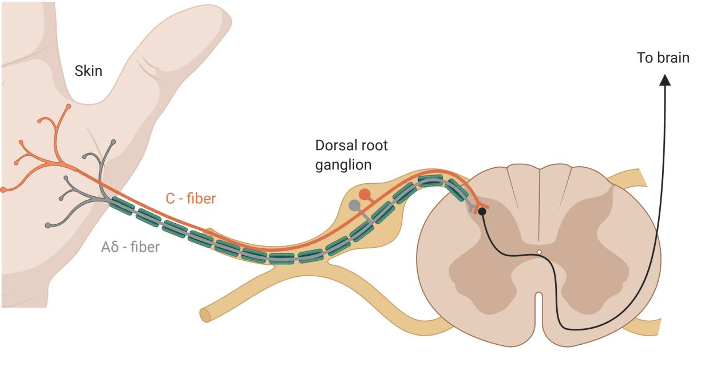
Pain is different from nociception. However, pain from injury cannot occur without nociception. The latter reffers to the process of detecting injury by the activation of a special class of receptors found in the skin, as well as deep tissues and organs, known as nociceptors. The detection of potentially or actually damaging stimuli is followed by a reflex withdrawal reaction, or nociceptive behaviour, mediated by nerves in the spinal cord. The nerve fibres that detect noxious stimuli are Aδ fibres and C fibres, which have their cell bodies in the dorsal root ganglion (DRG) of the spinal cord, as shown in Figure 2.

Figure 2. Illustration taken from a student presentation at Heidelberg University, Germany.

Aδ fibres are mechano-nociceptors, meaning that they are activated by high mechanical pressures. C fibres are polymodal, which means that they respond to a variety of noxious stimulations, such as noxious chemicals (e.g., acids), extreme temperatures and high mechanical pressures. They not only encode the stimulus modality (type), but also their intensity and duration, which are relayed to reflex centres in the central nervous sytem, mediating withdrawal reactions.

The nociceptive information travels from the DRG to different parts of the brain via spinothalamic tracts (from the spinal cord to the thalamus) and sensory fibres of the trigeminal tract (from the face to the thalamus). And it is within the brain that pain happens.

Pain is a complex feeling. Many brain areas are involved in not just generating pain, but also in ameliorating it. Structures from the limbic system, such as the amygdala, receive and integrate nociceptive and affect-related information. The amygdala can lead to increased nocifensive and affective pain behavior, while, under certain circumstances, it can also contribute to endogenous pain inhibition. Pain is also processed in the hypothalamus, the basal ganglia, the insula and the somatosensory cortices. Because these areas play a role in metabolism, as well as fear, pleasure and homeostasis, the nociceptive information is integrated and modulated according to the current state of the individual. In some situations, pain becomes pathological, as it is the case in neuropathic pain, where either previously innocuous stimuli become painful (aka, allodynia), or previously painful stimuli become even more painful (aka, hyperalgesia).

There are two brainstem structures, which are highly involved in controlling pain and generating analgesia. One of them is the periaqueductal grey (PAG) and the other is the rostral ventromedial medulla. These regions exert control over pain to prioritise competing stimuli, and to maintain homeostasis and survival. You might have noticed that, in highly stressful situations you do not feel pain. This is known as stress-induced analgesia, a phenomenon whereby the brain responds to stress by the production of endogenous opioids that act as natural analgesics in the nervous system. The opioid receptors found in the brain are the same ones which analgesic drugs, such as synthetic opioids and morphine, act on to relieve pain.

The evolution of pain

Many animal taxa have nociceptors. A schematic of the evolutionary development of nociceptors and the types of noxious stimuli they respond to is presented in Figure 3. In order to process nociceptive inputs, animals need a central nervous system (spinal cord and brain). It might come as a surprise that such a system, though at different levels of complexity, is found in all kinds of animals, including insects (like Drosophila melanogaster, the fruit fly), C. elegans (a type of worm highly studied in neurosciences), fish, amphibians, reptiles, birds and, of course, mammals.

Figure 3. The different types of nociceptors across animal taxa, from an evolutionary perspective.
Taken from Sneddon (2017)

Life-history shapes pain perception. A very interesting example is the African naked mole rat, which lives in underground burrows that are poorly ventilated, hence contain high carbon dioxide levels. As a result, the C fibres of the naked mole rat are unresponsive to acid, which means that, while other mammals find acidic environments nociceptive, the African naked mole rat does not.

When it comes to acquatic animals, such as manatees, they are expected to have differences in their sensory system compared to terrestrial ones, due to distinct ecological and evolutionary pressures. In water, any chemicals become dilluted, shifts in temperatures are less common, and there is no mechanical damage due to falling. Thus, acquatic animals are possibly at a lower risk of damage than terrestrial animals, which has implications on their nociceptive system.

As far as manatees go, it is still unclear to what extent they feel pain. The fact that they are an endangered species makes is difficult to study them. But given that they posses a very well-developed somatosensory system, which is even more advanced than in other mammals, it is expected that manatees are familiar with pain. Moreover, we still do not know enough about their stress, fear, memory and pleasure systems, which all play a role in pain processing.

It would be great if we managed to achieve a better understanding of these amazing marine animals. But, until then, let us enjoy their existance peacefully, without interfering violently with their lifestyles and without exposing them to any potential pains.

For a more in-depth view on pain, as well as more information about manatees, I highly encourage you to read the papers and articles listed in References.

Special thanks to Isuru Priyaranga for creating the cover image. He is a fellow blogger and YouTuber, and I highly recommend visiting his blog and YouTube Channel.

References

Animals are more than we think: Empathy and social intelligence in animals

Our experience with animals has shown us that they are not mindless creatures, functioning solely based on their instincts, as Skinner’s behaviourism suggests. In fact, many animals exert characteristics generally thought to be uniquely human. This idea is important not only because it challenges our efforts to answer the ancient question of what actually makes us humans, but because it could also influence the way we interact with animals.

Several studies, either using behavioural, observational approaches, or looking at bodily chemicals and genes, have so far demonstrated that non-human animals, such as different species of primates, elephants, corvids, mice, dogs, dolphins, octopuses etc. show, to various degrees, traits otherwise believed to only pertain to humans. These traits include self-recognition, tool-making, co-operative behaviour, culture and, last but not least, empathy.

Own image

What is empathy?

Empathy is an innate ability to experience and share the mental state of others.

Kitano et al. (2020).

Scientists are still trying to elucidate which behaviours are truly empathic, as well as the underlying mechanisms of empathy. According to Frans B.M. de Waal, professor of Primate Behaviour and of Psychology at Emory University, USA, empathy can manifest through an emotional (bodily) channel, which includes behaviours such as motor mimicry, synchrony and emotional contagion, as well as through a cognitive channel, in the form of self-other distinction and perspective thinking (when one takes the perspective of somebody else). According to him, mammals definitely show the former type of empathy. When it comes to the latter, which seems more likely to be unique to humans, he demonstrates that, for instance, primates are able to manifest consolation towards a conspecific who has been defeated in a fight, as well as that they possess an understanding of justice.

Manifesting a sense of fairness or justice involves the ability of an individual to recognise and respond to inequitable outcomes between themselves and another individual. Brosnan and de Waal (2013) have observed that capuchin monkeys, chimpanzees and dogs react negatively to continued inequity between themselves and a social partner. These animals refused to continue participating in interactions in which the outcome is constantly less good than a partner’s. Moreover, they also exert pro-social behaviours, i.e. they would help their social partner achieve an outcome that they could not otherwise achieve on their own. All these points about empathy are presented more at-length by de Waal himself in a TED talk, which I highly encourage you to watch.

Aside from the above-mentioned ones, another sign of empathy is helping behaviour, or the attempt to help a conspecific get out of a distressed situation. Although it might not come as a surprise that highly intelligent animals, like primates or elephants, demonstrate helping behaviour, rodents do it, too. One of my previous articles mentions a study from 2011, by Bartal et al., in which one free rat occasionally heard distress calls from a second rat trapped in a cage. The first rat then learned to open the cage and freed the other one, even when there was no payoff reunion with it.

This kind of social cognition that allows rats to recognise consecifics and perceive their distress is also seen in another rodent species, the prairie vole (Microtus ochrogaster). Many studies regarding social behaviours and the neuropeptide oxytocin, known for its role in empathic responses and sociality, have been carried out in prairie voles. In a very recent paper, currently available on bioRxiv, Kitano et al. (2020) investigated helping behaviour in prairie voles, in which the receptor for oxytocin has been knocked out (the OXTrKO voles), meaning that it was absent. In an initial experiment, the researchers showed that prairie voles help a conspecific soaked in water by opening a door to a safe area. The soaking in water was used as an aversive situation, which caused distress in the soaked animal. In a following experiment, when the cagemate was not soaked in water, the voles did not open the door as quickly as in the first experiment, which suggested that the distress of the conspecific is necessary for learning door-opening behaviour. In the absence of the oxytocin receptor (knockout), the OXTrKO voles demonstrated less helping behaviour than the wildtypes (which had the receptor), pointing to the role of oxytocin in helping behaviour. It was hypothesised that the helper vole shared the soaked vole’s distress through emotional contagion, which motivated the helper to open the door.  

Lastly, let us turn our attention to an invertebrate animal, whose intelligence and abilities to use tools, solve problems and escape confined spaces are widely recognized – the octopus (Octopus vulgaris). This animal has three-fifths of its neurones in its arms (which it can regrow), but its brain is just as impressive. With around 300 million neurones, octopuses have a brain-to-body-mass ratio similar to that of birds and mammals; their brains support decision-making, observational learning, good spatial memory, and camouflage behaviour. Octopuses, unlike humans, are not social animals, which means that what their learning is not based on parental guidance, co-operation or communication, rather it depends entirely on their own interraction with their surroundings. Moreover, octopuses have some neurochemicals similar to those of humans, such as serotonin, oxytocin and vasopressin, which are important for positive emotions. Another interesting fact is that octopuses seems to have personality traits similar to those of humans; octopuses appear to exert temperamental differences, which closely resemble those found in humans, such as extroversion/introversion and neuroticism/emotional stability traits. It is not yet clear whether octopuses have consciousness or are capable of empathic behaviours. Having said that, the Netflix documentary My Octopus Teacher might suggest just that.

In conclusion, there is clear evidence pointing to the existence of human-like characteristics across animal species, which suggests that we still have a lot to learn from them. Sadly, our relationship with animals is, in many ways, abusive, and we often tend to perceive them as lower-ranking beings, meant to be turned into food, clothes and decoration in our homes, or experimental tools in our labs. I wish we could be more empathetic towards animals, and more intelligent in the way we interact with them. They deserve that and much more…

References